The following information was written by Dr. Stephanie Sorrell, Prof. Séverine Tasker, Dr. Sam Taylor, Dr. Emi Barker, and Prof. Danielle Gunn-Moore
What is feline infectious peritonitis (FIP)?
Feline Infectious Peritonitis (FIP) is a condition associated with a type of coronavirus that affects cats only. This virus is different from coronaviruses that affect humans and does not pose a risk to people or other species.
Coronaviruses are commonly found in cats, and many cats may carry them without showing signs of illness. The presence of a coronavirus alone does not indicate that a cat has FIP, and additional evaluation is required to determine whether a specific condition is present.
Only a licensed veterinarian can assess a cat’s health, perform appropriate testing, and determine next steps. This information is provided for general awareness purposes only and is not intended to diagnose or guide medical care.
What cats are more likely to get FIP?
We do not know why certain cats develop FIP and others do not, but it is diagnosed more often in:
Cats under 2 years of age
Pedigree cats
Cats in multi-cat homes
Care for FIP Is Available from Stokes Pharmacy
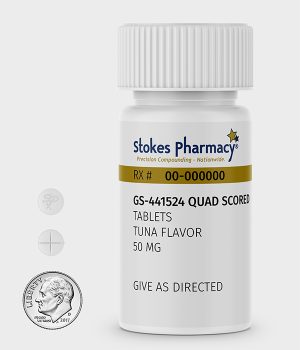
Stokes Pharmacy has formed an exclusive partnership with the Bova group to offer a U.S.-made oral option for FIP. This support is backed by Bova’s unique formula, which has been utilized in clinical research studies.
This is an antiviral with a broad spectrum of activity against RNA viruses. It is indicated for use in cats and kittens for feline infectious peritonitis (FIP).
The only oral formula identical to the Bova formula used in clinical studies
Veterinarians can legally prescribe
Ready to ship same day nation-wide
Order Today!
View all drugs, bulk pricing and order online at ifill.com
For Office Use: 888-508-5032
*not available for office use in AR, NM, NY, OR, RI, WV
Patient Prescription: 800-754-5222
Different Types of Feline Infectious Peritonitis (FIP)
Wet FIP
When fluid develops in a body cavity - especially the abdomen and/or chest
Dry FIP
When no fluid forms
Neurological FIP
Brain and/or spinal cord
Ocular FIP
Affecting the eyes
Symptoms of Feline Infectious Peritonitis (FIP)
What are the symptoms of FIP in cats?
Cats with FIP can show a variety of signs as the disease can affect any organ in the body. The most common signs are:
Lethargy/tiredness
Eating less and losing weight
A high temperature
Additionally, the disease can cause fluid to accumulate in the abdomen/belly, chest and occasionally around the heart (so called ‘wet’ FIP) so owners may notice a swollen, rounded belly or the cat may have difficulty breathing. The non-effusive (‘dry’) form can affect any organ including the intestines, lymph nodes, brain, kidneys and eyes. Many cats have a combination of ‘wet’ and ‘dry’ forms of FIP and some cats have pale, slightly yellow gums.
If the brain or spinal cord is affected cats will show signs such as fits, an abnormal way of walking (wobbly gait), changes in behavior or trembling for example.
If the eyes are affected they may look cloudy, bloody or with different pupil sizes, and the cat may show signs of pain such as holding the eye or eyes closed.
Treatment for Feline Infectious Peritonitis (FIP)
How is Feline Infectious Peritonitis (FIP) in cats treated?
In the past, limited options were available for cats affected by FIP. Today, veterinarians may consider a range of approaches depending on an individual cat’s circumstances.
Any decisions regarding care duration, monitoring, or adjustments are determined solely by a licensed veterinarian based on professional judgment and ongoing evaluation. Responses may vary between cats, and only a veterinarian can assess progress and determine whether changes are appropriate.
This information is provided for general awareness only. Stokes Pharmacy does not provide medical advice, make care recommendations, or determine suitability, duration, or use of any medication.
Explore our support options
To See full offerings located under the FIP tab in our main menu
The Medications You Need. The Quality You Deserve.
With a partner like Stokes, you can be confident in the medications you receive and use. Our commitment to quality is put into practice in all that we do, for every patient we serve.
In an industry where regulations vary by state, and every prescription is custom-formulated, there’s a lot of room for error. Not at Stokes Pharmacy. We’ve always set the bar higher, voluntarily meeting and often exceeding the strictest compounding standards in the nation.
Why Stokes Pharmacy
Highest degree of quality for safe, reliable compounded prescriptions
Accredited by the Pharmacy Compounding Accreditation Board (PCAB®) for meeting and/or exceeding national quality standards
Multiple quality check points to ensure prescription accuracy